
 By Courtney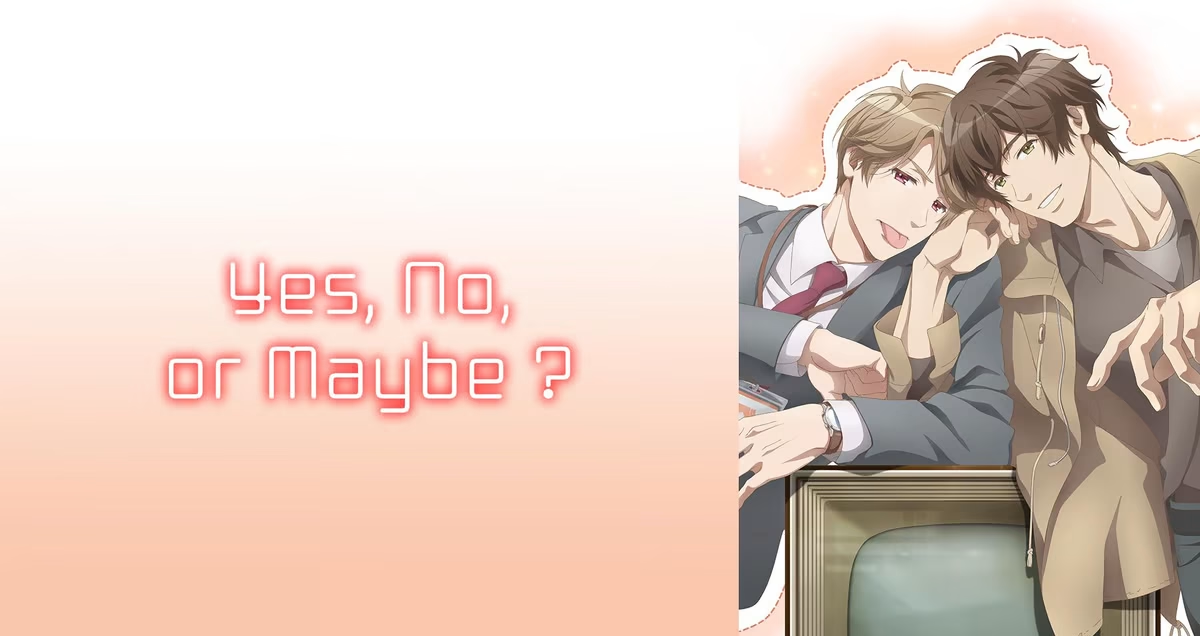
The anime of the month starts off deceptively innocent. Immediately, the audience is introduced to Kunieda Kei, the main character, who works as a newscaster for a major broadcasting network. On the outside, he seems utterly charming, with tousled dirty blonde hair, pink eyes, and a sweet smile. However, the anime director cleverly reveals what’s happening inside Kei’s mind through his internal dialogue and a sassy little chibi. This inner monologue is just as charming as Kei himself, though it contrasts sharply with the public persona he carefully maintains.
Kei’s internal world is filled with criticism, complaints, and dissatisfaction with his life. He knows that if he ever lets these true feelings slip, his public image as the “perfect” newscaster will vanish along with the identity he’s carefully built around it. Kei lives for work to maintain his pristine image and retreats into his personal life only to mask himself further. When he’s out and about, he wears a medical mask and glasses, giving him a few moments of respite from the “Mr. Perfect” act. In this disguise, he allows himself to be less prim, less polished—and even permits him to be disagreeable or in a bad mood.
The plot takes a turn when Kei runs into animator Ushio Tsuzuki while in disguise. He bumps into Tsuzuki, not looking both ways as he steps into the bike lane, injuring him in the process. When Kei realizes Tsuzuki doesn’t recognize him outside of his newscaster persona, he boldly pretends to be someone else entirely. He’s rude, unapologetic, and unkind—everything his perfect public self would never allow. Frustrated with the rudeness and injury, Tsuzuki punches Kei comically on the top of the head. In turn, he demands compensation in the form of help getting home and assistance with his animation project. Reluctantly, Kei agrees.
From here, the two form an unlikely bond, spending time together despite their general grumpiness toward each other. Through this relationship, both characters find moments of authenticity. Kei, under a false name and disguised with his mask and glasses, is able to express feelings and thoughts he would otherwise suppress, even admitting things to himself that he’s hidden for years.
As the anime progresses, Kei’s internal conflict becomes more evident. Toward the end of the hour-long animation, Kei lashes out when Tsuzuki tries to remove his mask and kiss him. In a heartbreaking moment, Kei slaps Tsuzuki and calls him a “disgusting pervert,” rejecting the growing feelings between them. This outburst is an expression of Kei’s internalized homophobia and his struggle to trust and understand his own feelings. It’s a painful moment for the audience, revealing just how much Kei cannot express his emotions or communicate openly with Tsuzuki.
After this incident, the two stop seeing each other, focusing instead on their careers. Kei gets a promotion he neither wants nor feels capable of accepting. Kei has a panic attack in a vulnerable moment before going on air. Just in time, Tsuzuki calls him, unaware of Kei’s inner turmoil. Kei asks for help, wishing that someone truly understood him, even as he hides behind his mask. Tsuzuki, recalling advice Kei had given him while in disguise, reassures him, helping Kei find the courage to face his professional challenge. Before going on air, Kei flips through a book he always carries for comfort. There’s a doodle of himself drawn by Tsuzuki on every page, transitioning from newscaster to his everyday disguise. This gesture reveals that Tsuzuki has been paying attention to him all along, seeing through his carefully crafted persona. He understood him perfectly despite the walls of miscommunication and deceit Kei had built between them. Against his best efforts, he is not only seen but also loved.
The story culminates in a charged moment between the two when they meet at Kei’s apartment. Things get steamy, yet Kei struggles to express his true feelings again. This interaction brings me to the story’s title: “Yes, No, or Maybe.” The title perfectly encapsulates the confusion and contradictory communication that Kei constantly projects. He doesn’t know what he wants, and he says the opposite when he does. When he wants to confess his feelings, he calls Tsuzuki “stupid.” When he wants to act on a romantic moment, he pushes Tsuzuki away. Kei challenges Tsuzuki—perhaps even testing him—to read between the lines and understand what he really means when he says “yes,” “no,” or “maybe,” even when his words contradict his intentions.
This dynamic is most apparent in the intimate scene, where Kei protests with clear language, saying, “Stop, I don’t want this.” Tsuzuki ignoring Kei’s protests may be troubling to many viewers, as it carries non-consensual undertones. I was initially shocked by the direction the film took, as the rest of the movie felt relatively innocent. But upon reflection, I found this moment to be oddly relatable. I’ve been in situations where I’ve been embarrassed to ask for what I want in bed, where I’ve said “no” when I really meant “yes,” and vice versa. Moments when I was nervous or scared but wanted direction from a partner to move forward and face those fears.
Fortunately, I have a partner who understands my body language and knows how to call my bluffs. I thought that was the case with the characters in this story as well. Perhaps I’m projecting, but this moment felt personal, resonating with my own experiences.
I want to emphasize that this perspective is specific to these characters, and I’m fully aware that others may see it differently. It’s important to note that this interpretation isn’t meant to justify or excuse behavior that would be problematic in other contexts. I understand if this moment feels uncomfortable, and I strongly recommend that anyone who finds these themes triggering approach this story with caution.
As someone who has struggled with expressing myself clearly in emotional and intimate moments, I found this story to be nuanced and impactful. It might not resonate with everyone, but I’m grateful I watched it, and I hope my analysis doesn’t offend anyone. Ultimately, it’s vital that we approach controversial stories in a way that feels authentic to ourselves, without feeling pressured to cancel them for fear of not fitting into the majority opinion.
I’d love to know what you think of this story. Do you feel the sketchy ending ruined an otherwise great narrative? Or does it perfectly encapsulate a complicated relationship? Please leave your thoughts in the discussion forum, and don’t forget to check out the podcast episode for this story on February 5th! Until then, remember that sometimes the delusion is the solution!
Yours in Deep Delusion,
Courtney